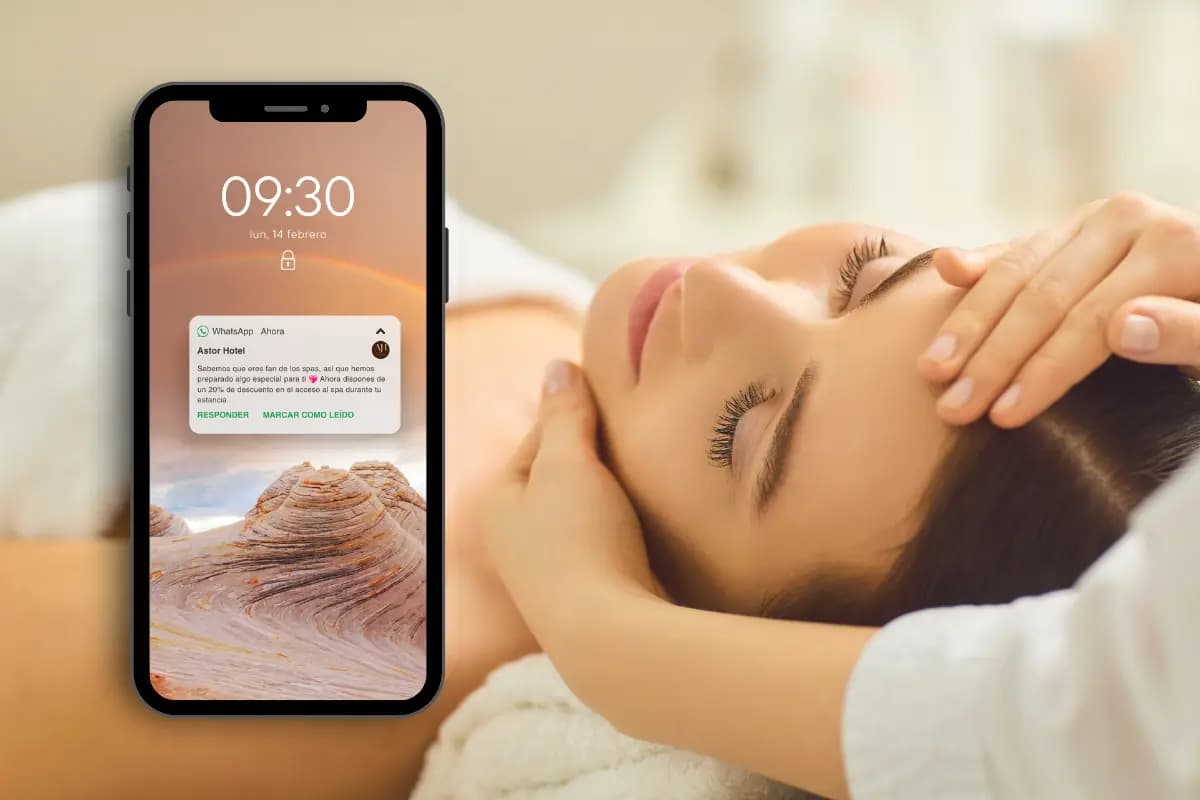
Want to take your hotel to the next level? Digital marketing is the key! In this practical guide, you'll discover how to implement effective digital marketing strategies to attract more guests and grow your revenue.
Get ready to take your hotel to the next level!
1. What is Digital Marketing?
Digital marketing (or online marketing) has become an essential tool for any business, and hotels are no exception.
Implementing a digital marketing strategy at your hotel can make all the difference when it comes to attracting and building loyalty among your customers. It also lets you reach a broader and more diverse audience, and grow bookings effectively.
Having an attractive, functional website, being present on social media, sending personalised emails based on tastes and interests, and using online advertising effectively are just some of the options digital marketing offers hotels.
In this guide you'll find useful tips and effective strategies to improve your online presence and succeed in the hospitality industry.
These days the term Marketing 4.0 is already in use: we're now entering the fourth generation of this online discipline.
How did digital marketing come into our lives?
With the arrival of the Internet, Marketing 1.0 (or web 1.0) was born, focused mainly on raising product awareness. The communication channel with the customer was one-way, meaning companies received no feedback whatsoever from consumers.
But this changes with the arrival of social media.
With the internet boom and the new possibilities for promoting products, screens started filling up with advertising, so a new need emerged: differentiating your product from the competition.
At this point, brands begin to create value propositions, the channel becomes two-way, and businesses start getting to know and listening to customers. A community of consumers is created.
All these changes mark the appearance of Marketing 2.0.
With Marketing 3.0, consumers no longer just want to buy a product: they want to buy values. To feel that, with their purchase, they're supporting a cause.
It focuses on linking the brand to social and environmental values and strengthens the sense of community.
At this point you might think there's nothing left to cover, but… there is.
Marketing 4.0 aims to anticipate the customer's needs. It seeks to become a human brand where communication is omnidirectional.
Anticipating the customer's needs means getting to know them, personalising their experience and making them feel special and, above all, heard. When it comes to hotels, it's during this process that the first seed of loyalty is sown.
2. Advantages of digital marketing for hotels
Digital marketing strategies for hotels have countless advantages, such as…
- The cost of launching an online campaign is much lower than that of a traditional one.
- Digital marketing redirects traffic to your website and grows your direct sales, allowing you to do without travel intermediaries.
- It has a higher ROI than traditional marketing.
- It lets you measure your results in real time.
- You can make immediate changes to your strategy, which in marketing is known as pivoting.
- There are no geographic or time-based limitations.
- Greater interaction with your customers, enabling you to build a community.
- Digital marketing for hotels segments your customers, so you can send them information that genuinely interests them.
- It lets you offer your customer a personalised experience throughout their guest journey.
- It's a loyalty tool.
3. Steps to create a Digital Marketing plan for hotels
A marketing plan is the document that captures the company's current position in the market, the goals you want to achieve, the strategies you'll carry out and the channels you'll use to reach them.
In scope, the digital marketing plan sits within the overall marketing plan. Therefore, the goals of both must be aligned.
The digital marketing plan focuses on the actions you'll carry out across digital media such as social networks, the blog, the website…
Your hotel's digital marketing plan should include:
3.1 An analysis of the current digital situation
Before setting our goals, and so they're realistic, we need to understand the environment our company operates in — in this case, our hotel.
To do this, it's advisable to break our analysis down into three parts:
a) Internal analysis
We need to know our own brand, and identify whether any aspect of it isn't well structured.
As this is a digital marketing plan, we'll focus on our digital media:
- SEO: Analyse and fine-tune our keywords to improve organic ranking.
- Google ranking: so, on which page does our hotel appear?
- Analyse your imagery: Are your website and social channels visually attractive? Is the purchase or booking process easy to complete? Is there constant, relevant updating?
- Reputation: what reviews are there about our hotel on Google or other platforms?
Having more social networks doesn't mean having a bigger presence. We need to analyse which social networks fit our target. Posting on LinkedIn isn't the same as posting on Instagram; the customer profile that uses each one and the content we need to publish are completely different.
We also need to make sure the content we publish is adapted to each platform: reusing the same content across all networks without considering formats, trends or user needs is no longer the way to go. In fact, if you want to create genuine engagement, think about creating transmedia content.
- Our blog content. The blog is a very useful tool when it comes to ranking for SEO, so we should dedicate the time it deserves to it and create an editorial calendar.
- Analysing the emails we send in email marketing. It's important to review our open rate, delivery rate, click rate, etc.
All of this should be complemented with what we call KPIs. KPIs are the key performance indicators. These indicators are essential for knowing whether the digital marketing strategy we're running at our hotel is being effective.
b) External analysis
Once we've analysed our internal behaviour, it's time to analyse what's happening in the market we operate in.
We need to identify our current and potential competitors, and classify them:
- Direct or first-degree competition. These are competitors operating in the same sector, using the same channels as us and targeting the same target market. The differentiation between our product and theirs is minimal or even non-existent.
- Indirect or second-degree competition. The difference from direct competitors is that, in this case, our product differs from the competition's.
- Substitute products or third-degree competition. They meet the same needs as our product and operate in the same sector, but don't share the same characteristics.
Once identified, we need to analyse their strategies, the market shares they hold and their sales volume; we can even look at which digital campaigns they've been running and the results they've achieved; this is known as benchmarking.
c) SWOT
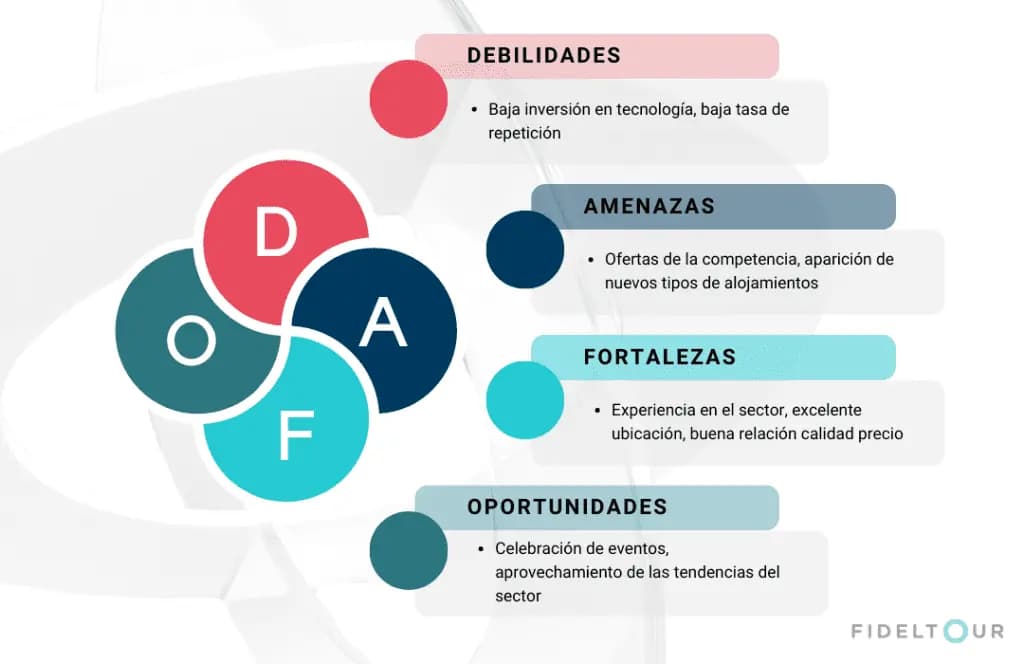
As a final step, all of the above can be summarised in a SWOT analysis (in Spanish, DAFO), which captures both the internal and external factors of our company.
The SWOT acronym stands for:
- Weaknesses of our company compared with our main competitors in the sector (internal analysis)
- Threats our company faces or could face (external analysis)
- Strengths of our company compared with our competitors (internal analysis)
- Opportunities for our company in the sector (external analysis)
An example of a SWOT analysis for our hotel would be…
3.2 Creating our buyer persona
Knowing your target audience is fundamental to implementing an effective digital marketing strategy at your hotel.
Identifying and segmenting your potential customers will let you tailor your messages and marketing actions to their specific needs and preferences.
Your buyer persona is an X-ray of your ideal guest.
It's important to carry out thorough research of your market and analyse data such as age, gender, geographic location, interests and the buying habits of your potential customers.
Once you've defined your market segments, you'll be able to design personalised marketing campaigns for each of them, which will increase the effectiveness of your actions and let you achieve better results in terms of conversion and customer loyalty.
What's more, segmenting your potential customers also lets you save time and resources by focusing on those segments that are most profitable for your hotel.
Can I have more than one buyer persona?
For a single product we can create more than one potential-customer profile. But we need to understand our market limitations and create a number of buyer personas consistent with them, since otherwise we could lose the focus of our strategy.
This doesn't mean we have to set aside the concept of target market when designing our digital marketing strategy, since both concepts are complementary.
The target market is much more abstract and less precise, but equally necessary, since it focuses on a part of the market, whereas the buyer persona is much more defined and given characteristics that make it human.
To make it clearer, here's an example for the case of a digital marketing strategy for hotels.
Buyer persona: Katia, 35, an administrative worker employed by the public sector. She is happily married with 2 children aged between 6 and 10. She loves to travel and, whenever she can, takes getaways either with the whole family or just with her partner. Katia likes sun-and-beach destinations, since she hates the cold. She really enjoys doing sport and fine-dining cuisine.
Target Market: woman aged between 30 and 40, with a stable job, a partner and children.
3.3 Setting goals
It's time to define the short- and long-term goals of our hotel's digital marketing plan. These goals are usually set with a 6- to 12-month horizon.
It's good to dream, but it's much better to be realistic. To do this, we'll use the S.M.A.R.T technique:
-
Specific: it has to be concrete. What do you want to achieve?
-
Measurable: it has to be quantifiable so it can be measured. Which KPIs are we going to use to measure them?
-
Attainable: they have to be realistic goals. How are we going to reach them?
-
Relevant: they have to be aligned with the role our hotel plays. Why is it important for our company?
-
Timely: we have to set a deadline. When do they need to be met?
3.4 Defining the strategies of our digital marketing plan
It's time to get creative and think about which tactics and strategies we can follow to achieve the goals of our digital marketing plan.
For each goal we'll need to develop a different strategy and specify an action plan to achieve it.
In point 5 we go into them in a little more depth.
At this point it's also important to define which channels we're going to use and what resources we'll allocate to each strategy or tactic.
3.5 Follow up
One advantage of digital marketing is that it lets us spot a mistake and adjust the strategy quickly.
To do this we need to define the KPIs (key performance indicators) we're going to use to measure our goals. To ensure a good follow-up, we need to review our metrics periodically and set ourselves short-term goals; for example, over 3 months.
Selecting the right indicators is fundamental, since otherwise we could get skewed results and misinterpret the effectiveness of our digital marketing plan.
4. Ways to measure success – KPIs
KPI is a term you've surely become familiar with by this point in our digital marketing guide for hotels.
Key Performance Indicators are indicators that measure our performance. In other words, whether the actions we're carrying out are bearing fruit… or not.
There are thousands of KPIs in the world of digital marketing, but not all of them are valid for evaluating the same strategy. Therefore, we need to define different KPIs for each action plan we carry out.
Let's analyse the main KPIs for the channels we might use in our digital marketing strategies for hotels:
4.1 The KPI on the website
Number of visits: in Google Analytics this value can be found defined by three variables:
- User: this is our visitor's ID.
Each browser or device associated with a person who visits our website. Google tracks this ID through cookies and recognises it every time they enter our web domain.
- Sessions: these are the interactions that take place on a website over a period of time.
The same user can open different sessions.
A session starts when the user visits our website for the first time and can end for three reasons:
- because there has been no activity for 30 minutes
- because it's midnight
- because the user has accessed the site through a campaign
It's much easier to understand with an example:
Case 1: let's imagine that you, a user, enter our website and browse 3 different posts on the blog. You leave our site and come back in. All of this happens without more than 30 minutes passing between one action and the next.
In this case you've opened just 1 session.
Case 2: now let's imagine you enter our site, browse 2 posts, take a quick look at our modules and leave. After 1 hour you come back in.
In this case you've opened 2 sessions.
The same happens if we're on the site at 00:00, since Google Analytics resets all sessions at the end of the day.
In the case of campaigns, it's when the visit is made through an organic search (SEO), a Google Ads campaign (SEM), a Facebook ad, via LinkedIn…
For example, if you, a user, enter our site through an organic search (SEO), leave, and come back in through a paid keyword (SEM), even if less than 30 minutes have passed between the two, we'd be talking about two different sessions.
- Page view: this is the total number of pages viewed on our site. Every time we refresh a landing page or click on it, it counts as another page view.
Generating engagement during browsing
- Bounce rate: a bounce is when a user enters our website and leaves without navigating within it, that is, without clicking on any other landing page or link.
This rate is calculated by dividing the sessions that started on a single page by the total number of sessions.
The bounce rate isn't necessarily a negative indicator, since it can depend on the structure of our site, which may consist of several landing pages or may have only the home page where all the information useful to our user is found. So, to interpret it correctly, we need to know the dwell rate.
- Dwell rate: This is the amount of time a user spends on our website.
In Google Analytics this value appears as “Average session duration”.
But it isn't a completely reliable value, since Google only counts the time of a “session” in which there has been some interaction on the page.
When it comes to understanding results…
- Conversion rate: this KPI is one of the most used in digital marketing. It measures the result a given action is achieving, whether that's getting the customer to download something, make a purchase, register…
This rate is calculated by dividing the number of goals achieved by the total number of visits and multiplying the result by one hundred.
Let's imagine our goal is for our customers to register on our site. In total, 20 people out of 100 visits we've received register. Our conversion rate is 20%.
Google Analytics lets us set different goals from which the page itself will calculate the conversion rates for us.
4.2 Social media
-
Audience growth rate: this tells us how much our following has grown on our social network.
It's calculated using the following formula:

Although followers are a factor to take into account, since they can give us a good reputation and greater visibility, much more importance is now placed on the quality of those followers.
In that case, it's much better to know where they come from: whether it's due to a campaign, a specific post, a promotion, etc.
- Post reach: this is the number of users who have seen our post. It's calculated as follows:

-
Engagement rate: this measures the interaction or participation (comments, likes, shares, mentions…) of our users.
We can measure it in two ways:
1. According to the reach a post has had:

2. According to our number of followers:

- Applause rate: in this case it measures the level of likes our post has in relation to all the followers we have.

- SOV (Share of voice): this helps us understand how relevant we are in the market; that is, in how many comments we appear, whether through a direct or indirect mention.

It's worth mentioning that Instagram, Meta and LinkedIn now offer their own custom metrics. If you use publishing platforms such as Later or Metricool, you'll also have access to monthly metrics by selecting the values you choose.
4.3 Email marketing
-
Open rate: this tells us the percentage of emails opened relative to the total number of emails delivered. It helps us identify whether our emails are reaching the inbox or, on the contrary, going to Spam.
-
Cancellation rate or churn rate: this is the number of customers or subscribers who unsubscribe. It's usually measured over a specific period of time.
Obviously none of us want our customers to unsubscribe, but sometimes it's impossible to prevent.
What we do need to keep an eye on is making sure this rate doesn't exceed 2–3%.

-
Soft bounce rate: this is when our email isn't delivered due to some technical and transient error, such as a server failure or because the recipient's inbox is full.
-
Hard bounce rate: this is when our email isn't delivered because the email address we sent it to isn't valid; that is, it doesn't exist.
4.4 Paid ads or campaigns
The metrics we'll explain below can be used for any kind of paid ad we run on social media, in campaigns or on our website.
-
Impressions: an impression or view occurs every time an ad loads on a web page.
-
CPM (cost per thousand impressions): this is the cost generated by a thousand impressions of our ad.
-
Click: a click occurs every time a user clicks on an ad.
-
CPC (cost per click) or PPC (pay per click): this is the cost generated when a user clicks on one of our ads. If they don't click, there's no cost.
-
CPA / CPL (cost per acquisition or cost per lead): in this case a cost is only incurred when there's a conversion. That is, if the user registers, downloads or buys.
It's the most expensive of the three.
-
CTR (click through rate): this measures how often users who see an ad, link, etc. click on it.
It lets us measure the usefulness of keywords, ads, campaigns…

And finally, one of the most important indicators in digital marketing, ROI.
- ROI (return on investment): this tells us what our gains are relative to the cost of the campaigns we are running or have run.

5. Digital marketing strategies for hotels
Now that we know which values to use when measuring the effectiveness of our campaigns, let's look at different digital marketing trends and strategies for hotels you can put into practice.
5.1 Inbound marketing
This new methodology was born in 2005 as a response to outbound marketing, an intrusive form of marketing with mass content distributed through traditional media focused on selling, selling and selling.
Inbound Marketing focuses on getting to know the individual and offering quality content to attract them through different digital channels.
In other words, the customer is the one who seeks us out, not the other way around.
With this new digital marketing strategy, besides adding value to our brand, we manage to reduce the cost of customer acquisition.
5.1.1 Stages of Inbound Marketing
It consists of 4 stages:
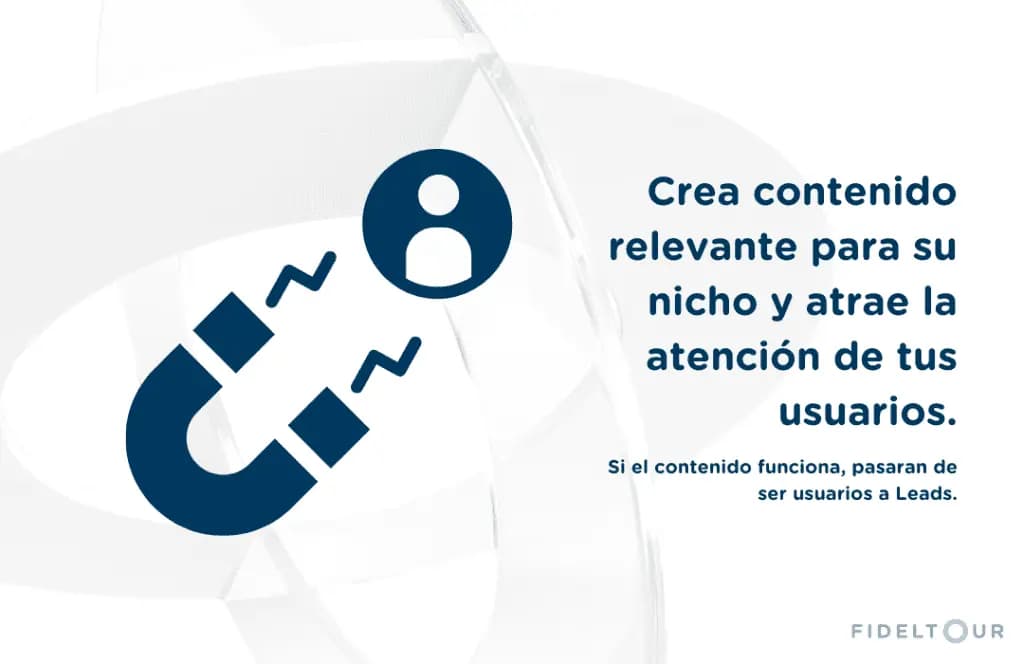
1. Attract: This involves attracting traffic to our website through content generation. The most important tools at this point are: the blog's Google ranking and our presence on social media, for example. It's not about reaching as large an audience as possible, but about attracting quality customers, that is, only those leads that have a chance of converting.
2. Convert: the next step is to convert users into leads, then into prospects and, finally, into customers.
To convert the user, we have to give them opportunities to leave us their information: you need a form (more or less detailed, depending on your needs) from that lead.
We can achieve this with what are called calls to action, or CTAs, which encourage the customer to act or take a particular action. They're usually buttons designed to grab the reader's attention and encourage them to click: “Download now!”, “Contact our team”, “What are you waiting for?”, “Subscribe”, etc.
One way to obtain this information is by sharing a free downloadable document, but one that requires an email or contact detail. Using, of course, a “Download free” CTA.
3. Close: in this stage we aim to convert leads into customers. To do this we'll need two new concepts: lead nurturing and lead scoring.
5.1.2 The differences between lead nurturing and lead scoring
Lead nurturing involves obtaining more information about our customer in exchange for offering relevant, quality content. Lead scoring, on the other hand, helps us identify whether a lead is “warm” or “mature” enough to convert into a customer and close the sale.
A very useful tool in this phase is a CRM for hotels like Fideltour, which will help us classify our leads and see how they evolve throughout the sales funnel.
5.1.3 The parts of the sales funnel
The parts of the sales funnel are:
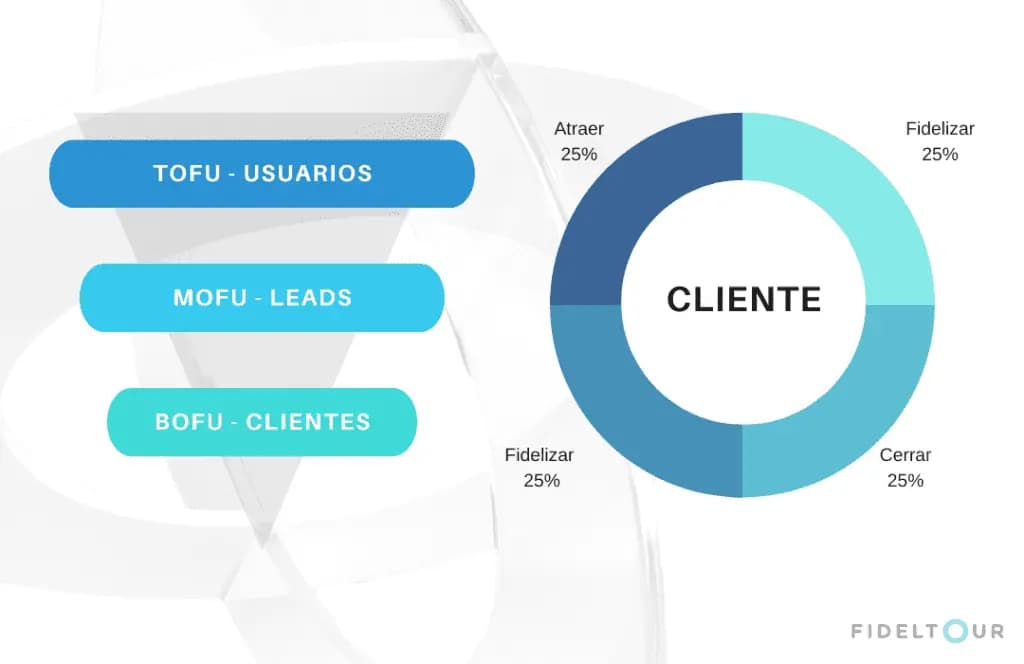
- TOFU (top of the funnel): cold leads, who don't yet know our brand.
- MOFU (middle of the funnel): warm leads, those who have shown interest in our product.
- BOFU (bottom of the funnel): hot or mature leads, ready to become customers.
4. Build loyalty: at this point we've already achieved our main objective, which is for the sale to take place: in this stage we focus on those who are already our customers.
What we're aiming for is to keep them, to keep offering them valuable content after their purchase and thus build their loyalty, and along the way turn them into ambassadors for our brand.
In other words, to benefit from what's known as word of mouth, since a recommendation influences the buying decision by anywhere from 20% to 50%.
Another big difference is that the traditional funnel model is left behind and we move to a flywheel, where the customer is at the centre.
We no longer talk about a process, but about a cycle that is in continuous motion.
2 Content marketing
Content marketing is one of the main tools of Inbound Marketing.
As its name suggests, it focuses exclusively on attracting customers through the generation of valuable content, and the goal of content marketing focuses exclusively on certain stages of the buying process.
What's more, content marketing can also occur in outbound channels, such as sending newsletters or articles in physical magazines.
A good digital content marketing strategy is essential for our hotel, and for that it's vital to have a content plan. A plan specifying what kind of content we're going to publish, how often and on which channels, so we can reach the largest possible number of potential customers.
Some content marketing tools and channels are:
-
Blog: websites with a blog generate 67% more leads, as well as boosting SEO ranking. It's therefore essential for the digital marketing of any hotel.
-
Podcast: podcasts would be like blogs but in audio format. The number of users keeps growing year after year, so it's a channel worth considering.
-
Social media: today, 59% of the world's population uses social media.
Therefore, not having profiles for our hotel on social media is NOT an option. Instagram, the most visual and interactive network of all, should be your first choice for your hotel.
5.3 Automated digital marketing and email drip
Automated marketing involves using software that lets you speed up the process of converting leads into customers, reducing the acquisition cost.
It's a fundamental strategy in inbound marketing, since it supports the development of two key processes of this strategy: lead scoring and lead nurturing, through frequent interaction with our potential customer.
Automated digital marketing makes it easier to apply the lead scoring system, since it helps us evaluate which level of the sales funnel (TOFU, MOFU or BOFU) our lead is at and whether they're a qualified lead or not for becoming a customer.
Meanwhile, by automatically sending emails when a specific action is taken on our website (making a booking, sending a contact message, downloading a document…), we create an interaction with the user, thereby contributing to lead nurturing. This means we can create an automated workflow.
What is a workflow?
A flow of work. An automated workflow consists of a series of digital marketing actions that are triggered based on the user's behaviour on our website.
A good example is an email drip campaign. It involves sending a series of emails to a group of subscribers, over a set period of time, in order to create interaction on their part using CTAs (calls to action).
These campaigns usually achieve a higher open rate than other emails and are part of the lead nurturing process.
To carry out all these actions, all you need is a good CRM like the one Fideltour offers you.
5.4 Search engine digital marketing: SEO and SEM
The goal of this digital marketing strategy is to improve our ranking on the SERPs (search engine result pages). We achieve this through two tools you've surely heard of at some point: SEO and SEM.

When we run an Internet search, two types of results can come up: one that's there naturally or organically, and another that's paid.
SEO or Search Engine Optimization
SEO is the acronym for Search Engine Optimization. SEO lets us improve our web ranking by optimising content. In other words, what ranks well for SEO are those pages that appear as the top results in the search engine without having paid for it.
These top positions are highly coveted, since 90% of people searching on Google only click on the first page that appears to them.
A very useful tool for working on our SEO is blog articles, since they help us optimise keywords and thereby get indexed on Google.
SEM or Search Engine Marketing
These are the pages that, when we run a search, appear first, above the first organic result, in the top left. Before the page's domain, the word “anuncio” or “ad” appears.
Those pages pay to appear in that position.
The most widely used tool in Spain is Google Ads (formerly Adwords), although there are other search engines such as Bing Ads, Yahoo Ads…
The question you're surely asking yourself right now is… How much does it cost to appear first? Is it very expensive?
There's no standard rate, since in the case of Google Ads the price is set through a keyword auction. Whoever pays the most appears first. What's more, as it's a bidding system, the price varies continuously.
The price depends on the type of campaign you run, the quality of your keyword and the “bidding” method you want to use.
The most used model is CPC (cost per click, which we explained earlier), but Google also offers the option of bidding using CPA (cost per acquisition) or CPM (cost per thousand impressions).
SEO and SEM are complementary and essential to a good digital marketing plan for your hotel.
The keywords of your SEM campaign
There are different keywords. Broadly speaking, we can divide them into two groups:
- Keywords according to search intent: search or navigation intent is the purpose for which the user ran that search.
This matters because Google's goal is to offer the individual what they're looking for, so we need to align our content and choose the keyword we're going to target with the user's intent in mind when they land on our website.
Campaign goals
Informational: the user is looking for information, such as “Best areas to stay in Mallorca”
Navigational: the user is looking for a specific site, such as “Hotel Almudaina”
Transactional: the user is looking to make a purchase or booking, such as “price per night for a hotel in Mallorca”
- Keywords according to their length
Head: very generic words, with a very broad search volume and high competition: “Hotel“
Medium: these are the most frequent searches. They're a little more precise than the previous ones but are still very generic searches: “Hotel in Barcelona”
Long tail: these are specific searches, mostly transactional, with a lower degree of competition: “Hotel in Barcelona for 2 nights”.
We've now covered every point of our “Digital marketing guide for your hotel”!
As you can see, there are thousands of concepts, indicators and strategies when it comes to creating and developing a marketing campaign.
Only one step left to take your hotel's loyalty to another level
We've gone all in with our digital marketing guide for hotels. Now that you know what it's all about, all that's left is to start putting it into practice.
Start by signing up and using the CRM for hotels Fideltour for free. Just click here to start centralising and segmenting your guests' data.
We also recommend taking a look at our marketing for hotels module if what you want is to ramp up your segmented and automated email campaigns.
If you'd like personalised support, get in touch with the team at Fideltour — we'll be delighted to help!
We'll leave it in your hands!